
Interest in the allegations against Sean “Diddy” Combs has surged with the release of a new Netflix documentary produced by Curtis “50 Cent” Jackson. The series includes interviews with jurors …
Day: December 8, 2025
Interest in the allegations against Sean “Diddy” Combs has surged with the release of a new Netflix documentary produced by Curtis “50 Cent” Jackson. The series includes interviews with jurors …
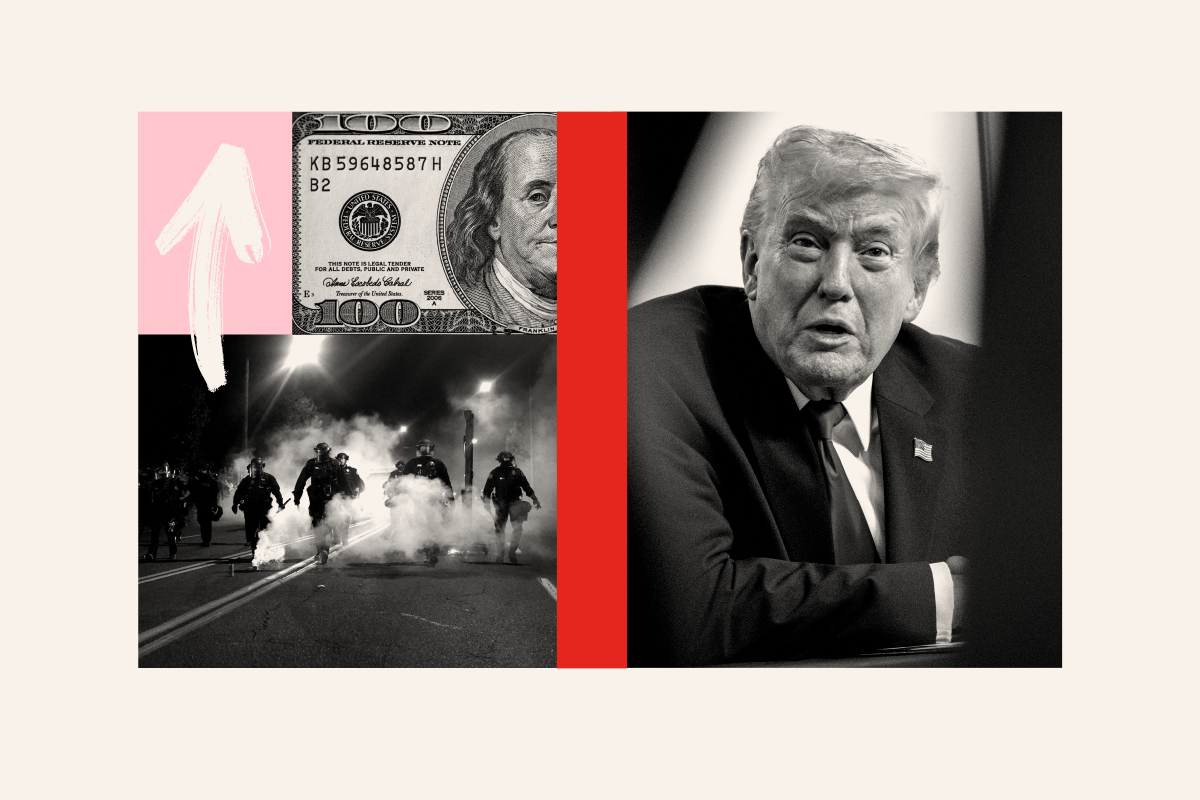
The Trump administration has awarded millions in contracts to companies providing less lethal weapons including pepper spray to the Department of Homeland Security.
The post Donald Trump’s Border Patrol weapons spending skyrockets first appeared on FBI Reform – fbireform.com.

The president’s oldest son once shunned his father to loaf as a vagabond in Colorado. He eventually came home, joined the family business and is amassing the kind of fortune that would make his father proud.
The post How Donald Trump Jr’s Fortune Jumped Six-Fold In A Year first appeared on FBI Reform – fbireform.com.
An owner/occupant has the option to rent his home on Airbnb/VRBO/Le Bon Coin or some similar service for a maximum period of 120 days in Paris (90 days in Nice). With this limitation, I am not clear how an owner can become a ¨super host¨.
First concocted by sailors of the British Royal Navy, adding Angostura bitters to a classic Gin & Tonic creates this simple, delicious cocktail that balances refreshment with depth of flavor.
Laura K. Field could not have picked a better month for the release of Furious Minds: The Making of the MAGA New Right. At the beginning of November, Kevin Roberts’ defense of Tucker Carlson set off a firestorm in the activist class over whether the “new right” is now too right. There was an ever-flowing stream of “takes” about how now-mainstream movements like national conservatism and postliberalism relate to the seedy underbelly of the right represented by Nick Fuentes or Curtis Yarvin. The basic identity of conservatism and “the right” is the topic du jour.
Picking up Field’s book in this environment, I hoped that it would provide an interesting framework for understanding where today’s right came from, how it relates to what has gone by the name “conservative” in the past, how it has gained ascendency so quickly across a wide swath of institutions, and how the various strands intersect and potentially clash with one another.
Unfortunately, Furious Minds doesn’t provide much beyond a meandering stroll down memory lane, with some subjective context and judgment thrown in here and there. It recounts some of the “greatest hits” of the new right over the past decade or so: Flight 93; Ahmari-French; liberalism failing; knowing what time it is; common-good constitutionalism; Red Caesar; Nate Hochman’s sonnenrad; and Tucker’s Low-T Special. If none of those sounds familiar, count your blessings. If any do sound familiar, then Furious Minds won’t add much to your understanding aside from serving as a basic, who’s-who manual.
She breaks down the new right into three groups: Claremonters (Straussians), postliberals, and national conservatives. If there is a through-line other than her own moral disapproval, it is the notion that all three reveal the problems with an “Ideas First” mentality, which essentially means they are enamored with grand visions and abstractions, while ignoring empirical reality. There is certainly something to that. But she leaves the concept underdeveloped and ill-defined. Often, it seems that it is merely her way of chastising her subjects for not being attuned to the “realities” of many left-wing shibboleths: “income inequality,” “racial inequities,” “gun violence,” “attacks on the LGBTQ communities,” etc.
That’s not to say that the book isn’t entertaining. We live in a time where one of the most influential ideological movements on the political right has among its ideas-peddlers an online persona named “Raw Egg Nationalist” who seems very, very interested in men. You can’t help but laugh at some of this, and a compendium of a decade’s worth of pseudo-intellectual clickbait inevitably has its moments. Entertainment value aside, though, there are serious questions to ask about emerging right-wing ideologies that ought to be a real cause for concern among those committed to freedom and constitutionalism. Unfortunately, Field doesn’t go very far beyond pointing and scolding. The book is limited in several ways.
First, it is fairly narrowly focused on people who straddle the line between intellectual life and popular political agitation. Podcaster and master of the Liminal Order, Jack Murphy, for instance, gets as much or more coverage than do Charlie Kirk, Ben Shapiro, or Candace Owens—presumably because he can be fitted more neatly into the Claremont circle of influence, and therefore as part of the intellectual side of things. Even Tucker Carlson, perhaps the most influential voice that has shaped the dynamics of the new right, mainly serves only to introduce us to certain “manosphere” types who have more academic backgrounds.
It’s perfectly valid to write only about the more “intellectual” side of things. But that focus does prevent the book from living up to its subtitle, which suggests a wider view. It also cuts off a potential explanatory avenue that is never explored: Perhaps some of the more extreme new right ideas Field chronicles took hold not because of their intellectual pedigree, but simply because there is an audience ready to click on and pay for shocking, transgressive rhetoric. The rise of this new right has, after all, parallelled the rise of monetized social media, which can mean massive payoffs for people—including self-understood “intellectuals”—who are willing to be dancing monkeys. The media personalities who clearly played a big part in the rise of “the MAGA New Right,” but who are nevertheless absent from the book, are primarily entertainers. Just because Bronze Age Pervert has a PhD doesn’t mean he isn’t doing the same thing.
Field ignores perhaps the most important causal explanation for the rise of the new right: the incredibly radicalized left.
In this sense, Field is herself utilizing something of an “Ideas First” approach, which she acknowledges in the introduction. Ironically, this winds up giving her more ridiculous subjects the benefit of the doubt—it treats them as essentially good-faith actors, developing ideas they are committed to. Very little attention is given to the question of grift. On the flip side of the coin, she also leaves the reader without a good sense of whose ideas are worth taking seriously and whose are not. As with most political movements, there are plenty of serious-minded people in these circles, along with some buffoons. Field gestures at such distinctions from time to time (when she discusses Christopher DeMuth, for instance), but she certainly rewards the loudest and most cartoonish voices with her attention, and thus probably lumps in some people who shouldn’t be in the same conversation.
Second, the analysis and judgment the book does contain seems to be heavily focused on Field’s own subjective experiences and ideological inclinations. In tracing out the intellectual roots of new right thinking, for instance, she devotes plenty of attention to Harry Jaffa, Allan Bloom, and (to a lesser extent) Harvey Mansfield—all of whom share the basic intellectual lane that Field was educated in. But there isn’t much about, for instance, the obscure Catholic thinkers that have inspired the new integralism, or the capital-T Traditionalism of Julius Evola and René Guénon that has reportedly been influential on Steven Bannon. The only reason I can surmise for the heavy Straussian focus is that Field is simply more familiar with those thinkers.
Here again, there’s nothing wrong with focusing on what one knows, but it should lead to a narrower thesis. I, for one, would welcome a systematic and critical assessment of Jaffa’s thought to see what if any elements of it might have primed some (though not all) of his acolytes to think of politics as a binary choice between two stark options, to flirt with the idea of an “American Caesar,” and to define away Americans they don’t want to have to deal with.
Jaffa tended to treat the constitutional and legal order in instrumental terms—defensible only insofar as it can be shown to have established the “best regime” that resolves internal tensions through the application of abstract, universal principles. And he approached Lincoln not simply with a healthy respect appropriate for a statesman navigating a time of crisis, but as a messianic figure who, transcending all temptations of power, “refounded” the country around a political religion. When his conservative critics argued that this might encourage perpetual “refoundings” and morally self-assured Caesarism, he often dismissed them—whether or not they had distinctly southern sympathies—by comparing them to Jefferson Davis. All that is to say, there is certainly some fodder there for a profitable study.
Field’s “ideas first” critique touches briefly on some of these aspects of Jaffa’s thought, but she is not particularly focused on teasing out the implications. Rather, she seems more interested in how his preference for abstraction served as cover for him to violate left-liberal pieties, namely, supporting Goldwater and opposing gay rights. Here again, her own ideological commitments seem to be the primary barometer of judgment.
Third, as other reviewers have pointed out, she ignores perhaps the most important causal explanation for the rise of the new right: the incredibly radicalized left. In my own reading and conversation, I have found that the most convincing argument deployed by the new right is some variation of “we’re already there.” The imperial, pen-and-phone presidency? Erosion of constitutional limits on power? Courts that consciously go beyond the established law to impose their particular view of the good? Coercion of citizens by law on matters of conscience and religion? Strategic plans to redirect culture by capturing institutions and stocking them with ideologues? Using civil rights law to impose policy demands on private institutions? The promotion of racial identitarianism? Economic class warfare? All of these things have been characteristic of left-wing activism for generations. And they have been carried out under the approving gaze of respectable liberal opinion.
These sorts of practices—coming from the right or left—are generally self-destructive; they empower demagogues, invite civil strife, and inculcate an attitude of servility among citizens who are told that they are victims of forces beyond their control and in need of a political savior. Far be it from me to engage in “whataboutism.” Most of my writing on such topics “punches right,” as they say, because those are the people I think should know better. But the reason some erstwhile conservative defenders of constitutionalism, decentralization, and limits have embraced radical ideas and strategies is because they have seen left-wing radicalism run rampant over old civil, legal, and constitutional limits already. And, in my own judgement at least, the new right is correct that the movement conservatism that was regnant in the early aughts did not resist this radicalism with much gusto. So people think fighting “fire with fire” is the only way. I think that conclusion is dangerously wrong when you’re trying to put out a fire, but it is not hard to comprehend.
If one wants to understand the “rise of the MAGA new right,” therefore, the most important places to look aren’t Straussian books from fifty years ago, Why Liberalism Failed, or the Collected Writings of Mencius Moldbug. They are Obergefell, Bostock, Obama’s “Dear Colleague” letter, and the average university’s equity and inclusion statement from 2020. The ideas promoted by the new right, either its intelligentsia or underbelly, are giving frustrated and overwhelmed conservatives what they want to hear.
Field acknowledges from time to time that some of the purveyors of new right ideas are drawing on left-wing sources, but the criticism suddenly gets muted in those instances, especially when it comes to economic policy. (She lavishes praise on Sohrab Ahmari for his commitment to a planned economy, for instance.) And she never suggests that the radicalism in her sights is only one part of a much broader phenomenon.
Ultimately, Furious Minds seems to be a book written by a center-left academic mostly for other center-left academics. It is certainly not designed to convince anyone tempted toward the new right, nor will it prompt any self-reflection from those on the left who have helped empower it. American civil life right now is in a spiral, and trying to pin it exclusively on the ideas of one side is not particularly enlightening.

Philanthropist is talking to US president as report shows childhood deaths will rise.
The post Why Bill Gates Thinks Donald Trump Cares About Global Health first appeared on FBI Reform – fbireform.com.
We often forget ourselves in this modern age, and one can’t help but feel that the amnesia is by design. For better or worse, the digital revolution has turned attention into a challenge and a commodity. Because of social media’s predominance, brain rot and doomscrolling are now part of everyday vernacular. Moreover, AI has raised serious questions about the nature of human consciousness, and distress about disinformation and polarization in the political sphere is rampant. Given these woes, Emily Katz Anhalt’s latest book, Ancient Wisdom for Polarized Times, hopes to remind us what it is to be human by enlisting an unlikely ally: the fifth-century BC historian Herodotus of Halicarnassus.
Herodotus was the father of history—or at least Cicero once granted him that title, and the name has stuck ever since. But more than Herodotus the historian, Anhalt aims to revive Herodotus the storyteller as a salve for our partisan ailments. And to that end, her book is less a tedious and exacting scholarly analysis of Herodotus and more a grand tour of Herodotus’s world, one that is punctuated with references to modern political issues from nuclear armament and gun violence to social media and minority rights. Along the way, Anhalt offers a kaleidoscope of classic stories from the Histories: Gyges’s overthrow of King Candaules, Arion’s miraculous salvation by a dolphin, Solon’s discourse on happiness with the wealthy Croesus, Peisistratus’s rise to tyrannical power in Athens, Themistocles’s trickery at the battle of Salamis, and much more.
The narrative thread or moral lesson that Anhalt finds in each of these stories is the centrality of human agency and the need for individuals to take responsibility for their actions, past, present, and future. But confronting our own choices also requires us to confront the notion of choice itself rather than shift the sorrows of the world off onto the “divine” or some form of unalterable chance. By underscoring the importance of human action throughout these stories, and by inviting us as readers to make judgments about those stories, Anhalt sees Herodotus as dethroning the tyranny of excuses in order to place the human being back at the center of our political considerations.
Anhalt’s book is especially strong when she explains how Herodotus writes and what his aims are. Herodotus has a deceptively simple writing style, and his own methodological comments are scattered throughout the Histories. Anhalt masterfully lays out how Herodotus invites his readers to join in his inquiries rather than simply take his conclusions as certain. For Herodotus, then, history “entails not the constraints of uncritical belief but the freedom of rational investigation and evidence-based ethical judgement.” It requires a constant give and take and a willingness to assess and reassess all opinions and all available evidence. Herodotus, Anhalt argues, saw history as more than just a useful tool for self-examination. It is “humanity’s best chance for survival.”
Anhalt regularly touches on the way in which Herodotus prods us to be better than we are. The ancient historian, she argues, “reminds us that reductive, polarized thinking pits us against one another—at the precise moment when our very survival depends on our ability to face facts, cooperate, and innovate together.” Here is a book that begs to be read and debated in a group or with a few friends rather than alone. Unity, community, and personal interaction are recurring themes throughout the work, most especially as bulwarks to tyrannical rule and a doorway to self-reflection and personal improvement.
Of special concern to Anhalt are “authoritarian falsehoods” of all stripes, be they political fabrications or the weeds of Internet anonymity. But more than that, Anhalt worries about the way in which those falsehoods undermine democratic practices by alienating us from one another and from genuine knowledge about ourselves. In her view, Herodotus’s Histories and the marvelous tales that it preserves provide something of a solution. Since “democratic institutions offer only part of the solution to the problem of good government,” Anhalt explains that “our stories must do the rest,” since the stories we tell necessarily influence “our goals and aspirations and the ways that we treat one another.”
A sober realism, not idealism, must guide our politics—and Herodotus helps to remind us as much.
In short, political life might be able to limp along with good procedures and institutions alone, but Anhalt maintains that it can never thrive without right habits, dispositions, and devotions. Here is where Herodotus the storyteller—a collector of fables, myths, and historical traditions—becomes invaluable. If we are going to rise to meet the problems of today, then we need to find good stories to inform and nourish our character—stories like those found in the Histories. “Now as then,” she explains, “Herodotus’s various stories” cultivate “his readers’ ability to distinguish fact from fiction,” and thereby train us to subject our most cherished commitments and deepest longings to scrutiny.
Of all the profound questions that Anhalt draws out of Herodotus, none is perhaps more pressing than her contention that his stories teach us to seek out “the least bad form of government” rather than “the best form of government.” Thus, a sober realism, not idealism, must guide our politics—and Herodotus helps to remind us as much. And since, as Anhalt contends, Herodotus saw democracy as the least bad regime, she concludes that he must have been an unapologetic democrat who wrote the Histories to support “people power.” Notwithstanding Herodotus’s emphasis on “reality” and “empiricism,” Anhalt still sees the ideal as worth studying and pursuing:
Idealism always forges ahead of reality, and the gap between the actual and the ideal will never close if we give up on the ideals. To ignore or deny crucial distinctions between modern liberal democracies and brutal dictatorships (and terrorist organizations) is to serve the agenda of dictators, racists, misogynists, kleptocrats, and terrorists. The differences may be smaller than optimal and sometimes diminishing. But Herodotus’s portrait of Athenian tenacity in the face of overwhelming odds should inspire us not to abandon the ideal of universal human freedom.
Anhalt thereby acknowledges that the Athenian democracy had flaws, especially when judged by modern standards. Despite their love of freedom, the Athenians “continued to keep people in slavery, subjugate women, enslave conquered peoples, and force allied cities to pay tribute.” Despite all this, she still places Athens on a pedestal throughout her work. At one point, she suggests that democracy simply is the “best” kind of political authority, or at least the only regime capable of becoming the best, and she later goes so far as to suggest that “human excellence” just is “a product of democratic freedoms.” What’s more, every regime other than Athenian democracy, without discrimination or justification, is referred to as an autocracy throughout the book—including Sparta, even though Lacedaemon is one of the only regimes Herodotus says “flourished” because of “good order” and “good laws” (Histories, 1.65-66).
Anhalt is hardly alone in suggesting that Herodotus was a partisan of Athenian democracy. But I wonder, given Anhalt’s own hermeneutic approach, whether the Athenian devotion to popular government and the subsequent degradation of all other regimes is not itself one of those passionate commitments that Herodotus hopes his readers will subject to intense scrutiny. Likewise, I wonder if more of this sort of scrutiny might help to convert our own uninformed political opinions into a truly reflective kind of patriotism. Anhalt, for example, worries that ignoring the real differences between liberal democracies and dictatorships will undermine human excellence—but it’s worth asking whether ignoring the differences between ancient direct democracy and modern representative government doesn’t do the same.
Consider, for example, Anhalt’s recognition that the American republic combines “elements of monarchy (the executive or presidency), oligarchy (the Congress), and rule by the many (one vote per citizen).” If all monarchies and oligarchies are “autocratic” and “destructive” in the way that Anhalt treats them throughout the book, one might question why the Founding Fathers ever dared to mix democracy with two evil forms of rule in the first place. To the contrary, the very fact that the American republic combines elements of all three classical regimes suggests that they each have their virtues and vices, strengths and weaknesses, and claims to legitimacy and temptations to tyranny.
To understand the real differences between modern republicanism and ancient democracy requires an almost Tocquevillian—or, better yet, Herodotean—openness to other regimes. Herodotus models this kind of openness to political alternatives in the Histories when he praises Persian courage as no worse than Greek (Histories, 9.62-62) and when he notes that legitimate kingship—in contrast to tyranny (5.92-93)—offers real political benefits, such as decisive or energetic action (1.127) and a means of maintaining unity (5.3). Such nuance would seem to be essential for a book that aims, as the title suggests, to offer Ancient Wisdom for Polarized Times. This, of course, is not to elevate authoritarianism over popular government, but to ask (just as Publius did in Federalist #9) whether the petty republics of Greece and Italy—just as capable of tyrannical actions in Herodotus as the other regimes (8.111 and 9.5-6, )—can be meaningfully categorized as the same kind of regime as today’s modern representative governments.
Nevertheless, Anhalt’s latest work is guaranteed to rekindle interest in Herodotus. Of special value is the way in which Ancient Wisdom for Polarized Times underscores the importance of stories by providing tales drawn directly from Herodotus for the reader to judge and digest. Every chapter contains a well-translated, unadulterated chunk of Herodotus’s Histories embedded within Anhalt’s own analysis and explanation. What’s more, each chapter of Ancient Wisdom for Polarized Times is self-contained and can be read without too much worry about what came before. The busy professional may not have time to slog through the whole of Herodotus’s prolix Histories, but Anhalt’s book provides an easy point of access to Herodotus and his wonderful world.